THE SANTA CLAUSE PROBLEM
A Brief, Unauthorized History of a Man, a Myth, and the World’s Least Audited Supply Chain
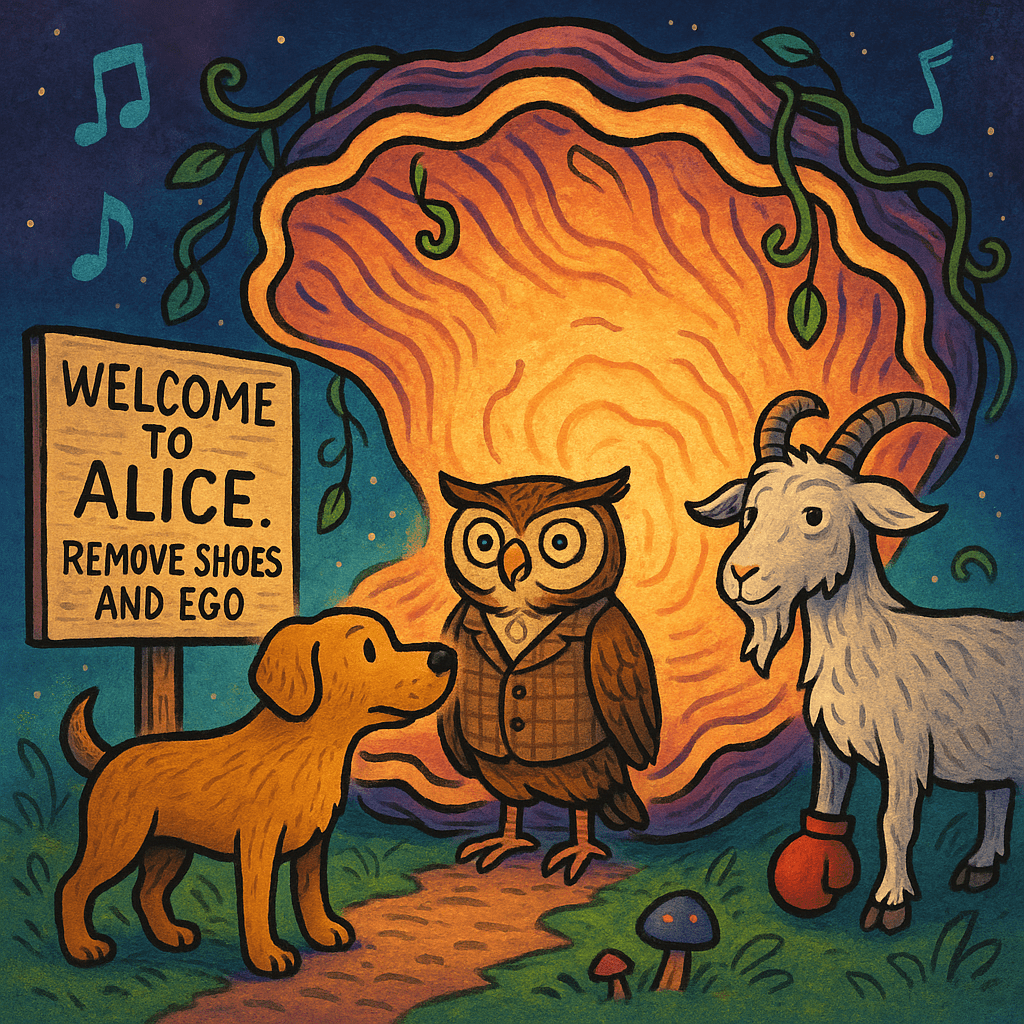
Filed for Scribe Safari. Marginal commentary provided by staff animals who have seen some things.
History maintains that Santa Claus has always existed—unchanged, eternal, and conveniently immune to scrutiny. This is soothing. It is also nonsense. Santa Claus was not born. He was assembled, revised, canceled, resurrected, rebranded, and eventually laminated for durability.
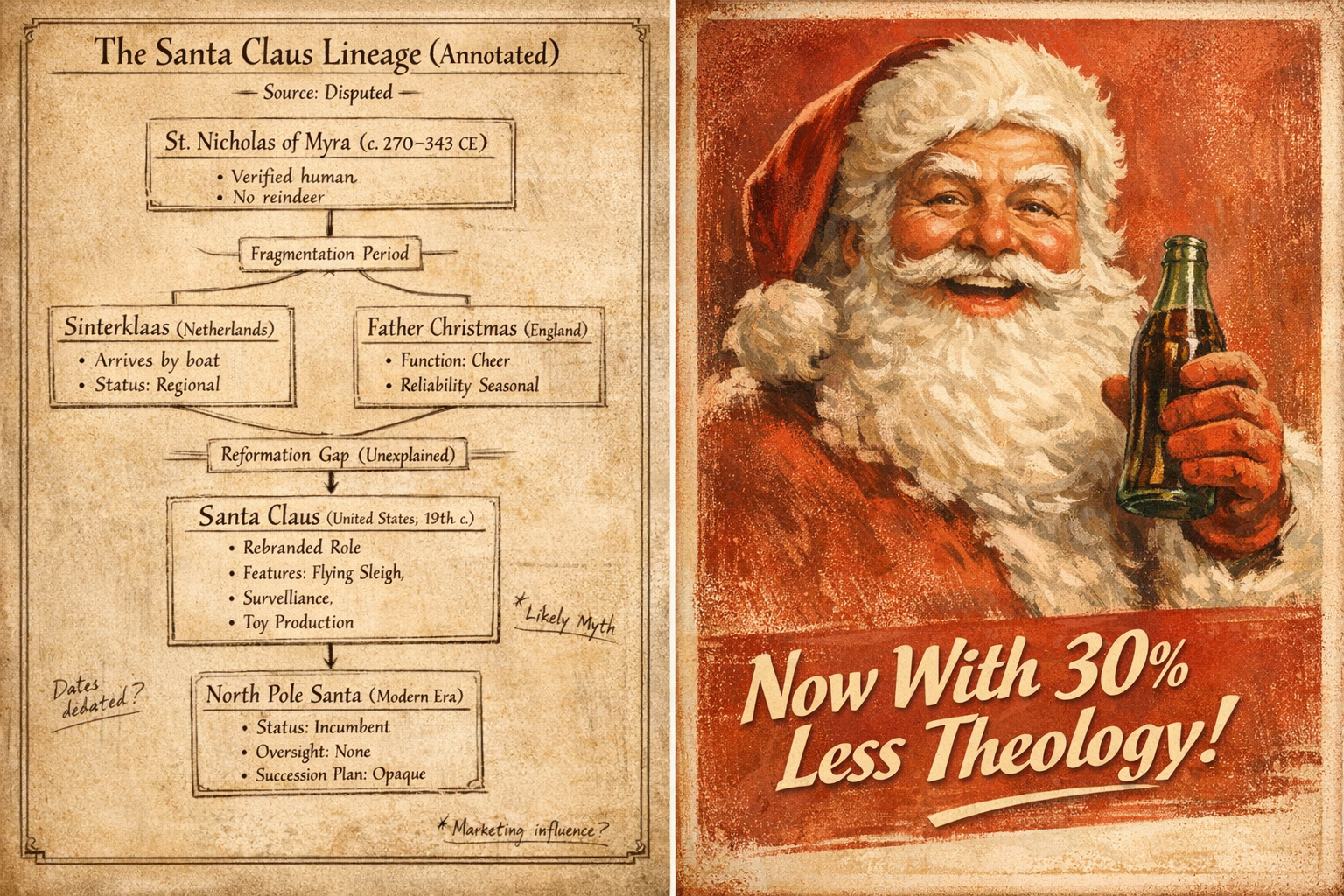
The first Santa Claus was a real person: Nicholas of Myra, a fourth-century bishop with a fondness for anonymous charity and an intolerance for theological nonsense. Church records suggest Nicholas once punched a heretic during the Council of Nicaea, making him history’s first saint to combine gift-giving with casual assault.
Bob the Dog (sidebar, tail thumping):
I like this guy. Sticks up for the little ones. Also for punching.
Nicholas gave quietly. He walked everywhere. He did not surveil children. He did not judge them. He did not own a factory. He died around 343 CE and—this is important—stayed dead, triggering what historians politely call The First Santa Succession Crisis and what modern HR would call a leadership vacuum.
THE AGE OF MANY SANTAS (OR: WHEN IT ALL WENT SIDEWAYS)
Without a governing body, Santa splintered.
In the Netherlands, Nicholas became Sinterklaas, arriving by boat with assistants best left unexplored in polite company. In England, he rebranded as Father Christmas, who dispensed cheer, alcohol, and very little merchandise. In Germany, he was replaced outright by baby Jesus—a hostile takeover if there ever was one.
Penelope the Owl (footnote, dry):
This is what happens when succession planning is left to folklore.
By the 16th century, Protestant reformers decided saints were inefficient, unbiblical, and suspiciously Catholic. Nicholas was quietly retired. Gift-giving was reassigned. Santa Claus vanished for nearly three centuries, reduced to a rumor and a half-remembered excuse.
THE AMERICAN REANIMATION PROJECT
Santa’s return did not occur in a cathedral. It occurred in New York, which should immediately raise concerns.
In 1823, a poem reintroduced Santa as a nocturnal trespasser with flying reindeer and an unhealthy interest in children’s behavior. This Santa was jolly, rotund, and aggressively unconcerned with theology. Illustrator Thomas Nast later relocated him to the North Pole, increased his caloric intake, and quietly converted him from bishop to executive.
Maurice the Goat (scrawled in the margin):
You give a man power, fur trim, and no oversight, he’s gonna start making lists.
By the 1930s, Santa wore red, smiled on command, and no longer mentioned God. Christmas was streamlined. Religion was removed. Consumption was installed.
THE ELF QUESTION (ASKED TOO LATE)
Elves appear in the historical record exactly when Santa’s workload becomes impossible.
This is not coincidence.
Early Santa gave coins. Modern Santa distributes toys at industrial scale. Elves—borrowed loosely from Norse folklore and stripped of all legal personhood—exist to explain how this happens without invoking sweatshops, time theft, or moral injury.
Bernice the Fly (hovering, investigative):
No birth certificates. No graves. No weekends. I checked.
THE SLEIGH LIE
Let us speak plainly: the sleigh is fiction.
Even with generous assumptions—elastic time, cooperative physics, structurally sound chimneys—Santa would need to make roughly 800 deliveries per second. This would liquefy a human body.
The conclusion is unavoidable.
Santa does not deliver presents.
Parents do.
Santa is branding.
Bob the Dog:
I suspected as much. Humans are very good at lying to their young.
MRS. CLAUS, OR: THE INVISIBLE INFRASTRUCTURE
Mrs. Claus appears late in the record, emerging just as Santa’s operation becomes unsustainable for one man in pajamas.
Her duties include:
- Feeding everyone
- Managing Santa’s moods
- Sewing
- Scheduling
- Emotional labor history declines to footnote
Before marriage, Mrs. Claus was likely a widow, a witch, or a woman who knew exactly what she was signing up for. Her first name remains unknown, which is itself a historical indictment.
Penelope:
Of course it does.
THE MYTH OF IMMORTALITY
Santa Claus is said to be immortal. This is incorrect.
Santa Claus is replaceable.
The man ages. The suit persists. The job continues.
Santa survives the way monarchies survive—through belief, repetition, and the quiet understanding that when one collapses, another will step into the role before the children notice.
Maurice:
Same gig, different beard.
Santa Claus is not a person.
He is a position.
Filed without permission. Fact-checked by animals. Approved by none.