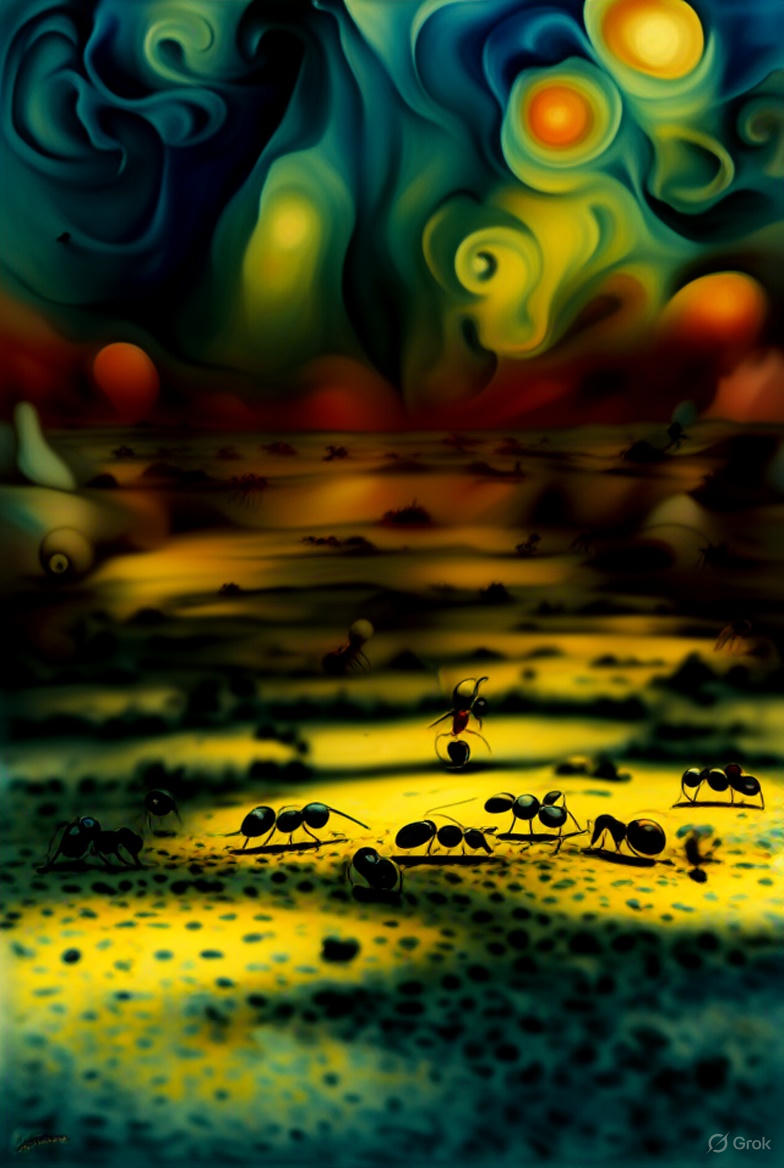
The Uninvited Guests of Central Texas
By Bernice the Fly (as told to someone who’s had quite enough, thank you)
The tawny crazy ants have come to Central Texas, and they’ve brought their entire extended family. One might almost admire their social organization, if one weren’t so busy watching one’s electronics explode.
They are called “crazy,” these ants, though I suspect the madness belongs to those of us who thought we could live peacefully in Texas without some fresh horror crawling up from the floorboards. The ants form large colonies—because of course they do—and they’ve taken it upon themselves to eliminate the fire ants, scorpions, and spiders. Which would be lovely, really, if they weren’t replacing the old tenants with something infinitely worse.
Some Central Texas residents have reported spotting the ants on their property. How delightful for them. One imagines the conversation: “Darling, come look at the patio. We have ants.” “How many, dear?” “All of them.”
TJ Greaney, a man whose ten acres are currently staging ground for an arthropod apocalypse, told Austin’s KXAN that he couldn’t look at the ground without seeing movement. One pictures Mr. Greaney standing very still, afraid to shift his weight, like someone who’s realized too late that they’ve walked into the wrong party.
But the ants aren’t content with mere conquest of the outdoors. They have ambitions.
“They’ll get up into your electronics,” Mr. Greaney explained, with what one imagines is admirable restraint. “Anything plugged in, anything where there’s any kind of voltage, whether it’s a vehicle or a flashlight or, deer feeder or a light socket. Anything they can get into…they will absolutely destroy it.”
Ah yes. Because what Central Texas really needed was an insect with a taste for infrastructure. The ants are drawn to electricity like moths to a flame, except the flame explodes and costs several hundred dollars to replace.
At the Brackenridge Laboratory’s Invasive Species Lab, research scientist Edward Lebrun is attempting to solve this delightful problem. The difficulty, it seems, is that the ants are colonial—nests sprawling across distances that would make a real estate developer weep with envy.
The researchers tried poisoning them with fungi. Spores were placed along the ants’ food path, one infected ant would toddle back to the colony and share the misery like a dinner party guest with a cold. But it didn’t work.
In his most recent research, Mr. Lebrun discovered why: the infected ants practice social distancing. The little martyrs isolate themselves in remote chambers, taking on tasks like corpse removal—how cheerful—rather than mingling with their healthier compatriots. One almost respects their sense of civic duty. Almost.
But understanding the ants’ altruism has given researchers a strategy. If they can infect the ants while they’re traveling—when self-isolation isn’t an option—the fungi might actually spread. The discovery may help reduce the harm being done by the invasive species.
Or it may not. But one must maintain hope, mustn’t one? Even as the ants march on, dismantling our deer feeders and shorting our light sockets, we soldier forward with our little spores and our desperate optimism.
The ants, I suspect, are not impressed.