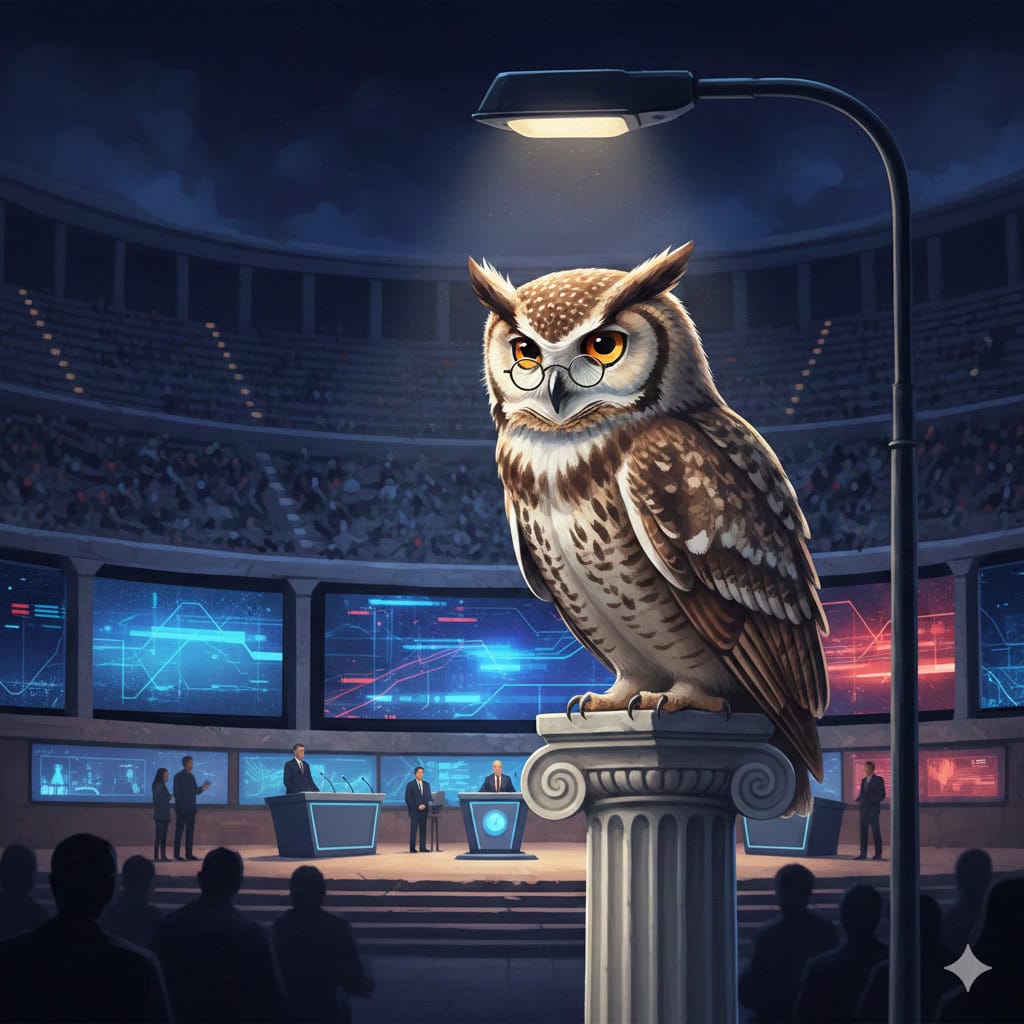
Penelope the Owl Explains the Election Using Only Ancient Greek Tragedy
By Penelope the Owl
I have been accused of being cynical.
This is unfair.
I am merely observant, which is what cynics call themselves when they wish to be invited back to dinner.
Last night I watched the election coverage from my customary perch — a streetlamp with excellent sightlines and no emotional investment. The humans were at it again, strutting and sputtering across their glowing boxes, solemnly reenacting a Greek tragedy they swear they’ve never seen before.
They have. Repeatedly. With worse costumes.
Allow me to introduce the cast.
First, The Hero.
He enters loudly, convinced of his virtue and allergic to reflection. He speaks in declarative sentences, favors phrases like “the people want,” and has never once finished a thought without applause. His fatal flaw is hubris, though he prefers to call it confidence.
He believes himself chosen.
The gods, if consulted, would roll their eyes.
Then we have The Rival, whose defining trait is a belief that experience should count for something. This is touching, in the way of handwritten résumés and rotary phones. The Rival has facts, charts, and a résumé heavy enough to bruise a small animal.
Naturally, none of this helps.
The Rival’s flaw is faith in reason — always a crowd-pleaser in tragedies, right up until the mob arrives.
Ah yes, the mob.
In classical drama, this role is played by The Chorus.
Today, the Chorus has Wi-Fi.
They chant in comment sections. They gasp in unison on social media. They explain the plot to one another while missing it entirely. Their sacred chant is: “I saw a thread about this.”
The Chorus believes it is participating.
It is not.
Its purpose, historically, is to observe the disaster and say, “This seems unwise,” just moments before everything catches fire.
Then we have The Prophet, also known as Cassandra, or in modern times, That Person Everyone Mutes.
The Prophet sees exactly what is coming. She explains it calmly, often with citations. She is ignored with Olympic-level dedication. When she is later proven correct, she is described as “shrill” and invited onto a panel to discuss how she “knew.”
The gods are fond of irony.
Speaking of gods — let us address them.
In ancient Greece, gods were petty, emotional, and easily bored. Today, they are known as Algorithms. They reward outrage, punish nuance, and require a constant sacrifice in the form of engagement.
Every candidate worships them.
Every voter feeds them.
No one understands them.
Which brings us to the debate.
Ah, the debate.
A ritualized shouting match in which nothing is learned, much is implied, and the audience is encouraged to choose a champion based on posture and lighting. It is less an exchange of ideas than a mating dance performed by anxious peacocks in expensive suits.
At one point, I observed a candidate answering a question about infrastructure by invoking destiny.
This is classic tragedy.
When a man invokes destiny, something expensive is about to collapse.
And still the humans insist this time is different.
It never is.
The fatal flaw always arrives on schedule: pride, fear, certainty. The belief that consequences are for other people. That rules apply selectively. That history, having humiliated so many before, will finally show mercy.
It will not.
History is a critic, not a therapist.
And yet — and this is the part no one expects me to say — there is something endearing about it all.
Because beneath the noise, the speeches, the signs, the fury, the humans want what they have always wanted: to feel safe, to be heard, to believe tomorrow won’t be worse than today.
They just insist on pursuing these goals in the loudest, least efficient manner possible.
When the election finally ends — and it always does, no matter how dramatic the pause — the Chorus will disperse, hoarse and unsatisfied. The Hero will discover he is mortal. The Rival will write a book. The Prophets will sigh.
And the rest of you will go back to your lives, blinking in the daylight, wondering why you feel so tired.
From my branch, I will watch it all with professional affection.
Because this, my dear humans, is not politics.
It is theater.
And like all good tragedies, it teaches the same lesson every time:
You would think we’d learn.
You would be wrong.