MIKE INVESTIGATES: HOW LONG SHOULD AN ANIMAL MASTURBATE?
An inquiry into self-love, zoological privacy, and the uncomfortable things a correspondent learns when nobody else wants the assignment
By Mike, Special Correspondent
There are questions a journalist asks because his editor tells him to.
There are questions he asks because the public deserves an answer.
And then there are questions that land on his desk at 10:37 on a Wednesday morning, wearing the greasy little hat of destiny, and cause him to stare out the window while wondering if there is still time to become a plumber.
How long should you masturbate?
I stared at the question.
The question stared back.
Neither of us blinked.
Finally, I did what any responsible journalist would do.
I tried to give the assignment to somebody else.
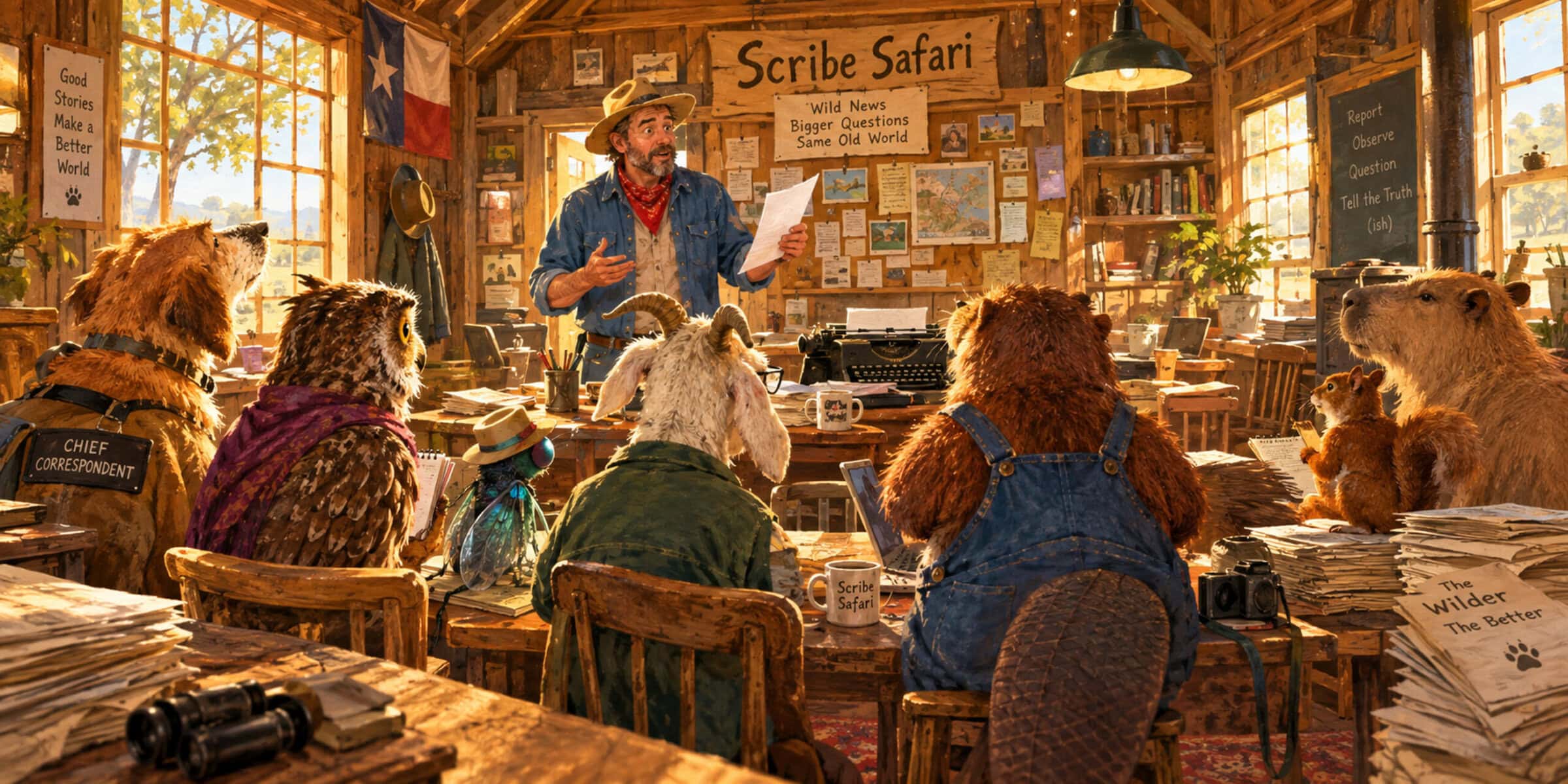
Bob the Dog said he had a deadline.
Penelope the Owl was covering a society luncheon where three debutantes, a ferret and a disgraced peacock were reportedly involved in a misunderstanding concerning a fondue fountain.
Bernice the Fly on the Wall said she was already embedded somewhere and couldn’t talk.
Maurice the Goat took one look at the assignment, chewed thoughtfully for approximately four seconds, and walked away.
That left me.
Which is how I found myself investigating one of the great unanswered questions of our time.
Not Why are we here?
Not Is there intelligent life elsewhere in the universe?
Not even Who keeps putting anchovies in the newsroom refrigerator?
No.
How long should a creature masturbate?
I began with science.
This was my first mistake.
Science, as it turns out, is surprisingly interested in masturbation but surprisingly reluctant to put a stopwatch beside it.
Scientists have documented self-stimulation in a wide variety of animals, particularly primates. Both males and females do it. Some do it in captivity. Some do it in the wild.
In other words, masturbation appears to be less of a human invention than we had previously imagined.
Humans merely invented the guilt.
And the magazines.
And the articles asking how long we’re supposed to do it.
Nature, meanwhile, appears to have adopted the more sensible policy of not timing everything.
A chimpanzee doesn’t apparently stop halfway through and consult a laminated chart. 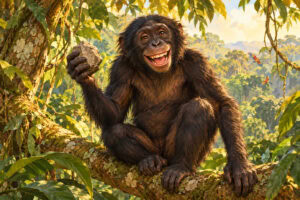
A macaque doesn’t glance at his wrist and say, Good heavens, I’ve gone over the recommended average.
An elephant presumably doesn’t maintain a spreadsheet.
Although, knowing elephants, I wouldn’t rule it out.
THE GREAT CLOCK OF SEXUALITY
Humans have an almost religious devotion to the clock.
We time eggs.
We time races.
We time steaks.
We time traffic lights.
We time how long it takes the microwave to destroy a burrito.
 And now we want to know how many minutes we are supposed to spend enjoying our own company.
The scientific answer is gloriously disappointing:
There is no universal number.
There is no International Council of Masturbation sitting in Geneva with little Swiss watches.
There is no committee of elderly zoologists standing beside a giant stopwatch shouting, “That’s enough, Gerald!”
Human beings vary.
Animals vary.
Bodies vary.
Desires vary.
The universe, which has been around for roughly fourteen billion years, does not appear particularly interested in our schedules.
This led me to a more interesting question:
Why do animals do it at all?
And here things became strange.
Researchers have suggested several possibilities.
It may have reproductive advantages.
It may have something to do with sperm competition.
It may reduce the risk of certain infections.
It may be a way of practicing sexual behavior.
Or—and this is the possibility I find most appealing—it may simply feel good.
Imagine that.
Perhaps evolution occasionally produces something pleasurable without requiring us to write a twelve-page explanation of it.
Perhaps sometimes a cigar is just a cigar.
And sometimes a beaver is just having a private afternoon.
THE MACAQUE WITH THE TOOL
Then I discovered something that nearly caused me to fall out of my chair.
Some monkeys have been observed using objects during sexual self-stimulation.
Tools.
This means that somewhere in the evolutionary family tree, while our ancestors were still contemplating whether rocks were edible, a monkey apparently looked at a stone and thought:
“I have an idea.”
Human civilization may have begun with fire.
Or the wheel.
Or agriculture.
But somewhere in the shadows of prehistory, there was probably a monkey standing beside a rock thinking, This changes everything.
I decided it was time to interview Drummond the Beaver.
Drummond is our military and water-lodging correspondent, a handsome, irritable fellow with the emotional warmth of a frozen dam.
I found him behind the newsroom, contemplating an orange.
“Drummond.”
He looked at me.
“Mike.”
“Do beavers masturbate?”
He continued looking at the orange.
Then he looked at me.
Then at the orange.
“That’s a personal question.”
“I’m a journalist.”
“That’s not an answer.”
“It’s my job to ask personal questions.”
“Then get another job.”
I wrote that down.
“Do you know whether beavers masturbate?”
“I know many things.”
“Such as?”
“I know that a tree falling in the woods makes a sound whether you’re there or not.”
“That’s philosophy.”
“No. That’s forestry.”
THE ORANGE
I noticed that Drummond was still holding the orange.
“What’s with the orange?”
“It’s an orange.”
“Why are you holding it?”
“Because I can.”
“Is it related to the investigation?”
“No.”
“Are you sure?”
“Mike.”
“Yes?”
“Go away.”
I went away.
A journalist must know when he has reached the outer boundary of useful inquiry.
I had reached it.
Possibly several questions earlier.
THE MIKE PRINCIPLE
After days of research, interviews, furtive glances at zoological literature and one conversation with a squirrel who became visibly uncomfortable when I mentioned the word macaque, I arrived at a conclusion.
The question How long should you masturbate? is probably the wrong question.
A better question is:
Are you enjoying yourself, and is it causing a problem?
Nature seems to have been operating under this general principle for millions of years.
Humans, naturally, have responded by inventing anxiety.
We worry about frequency.
Duration.
Technique.
Normality.
Whether we’re doing it too much.
Whether we’re doing it too little.
Whether somebody else is doing it better.
Meanwhile, somewhere in the forest, a monkey is having a perfectly ordinary afternoon and has not once checked the Internet.
Perhaps there is wisdom in that.
Perhaps the animals know something we’ve forgotten.
Perhaps pleasure doesn’t require a performance review.
Perhaps the body is occasionally allowed to be a body.
And perhaps, just perhaps, we could learn something from the creatures with whom we share this absurd blue planet.
Except beavers.
Beavers are different.
I called Drummond one final time.
“Drummond?”
“What?”
“I’ve finished the story.”
“Good.”
“I didn’t mention the orange.”
There was silence.
“Thank you.”
“One question.”
“What?”
“Why were you so worried about the orange?”
Another silence.
Then:
“Mike.”
“Yes?”
“Some mysteries are best left mysterious.”
He hung up.
I looked at my notes.
Then I looked at the orange sitting on my desk.
I have no idea how it got there.
This is Mike, reporting for Scribe Safari, where no subject is too strange, no question too personal, and no orange is ever merely an orange.