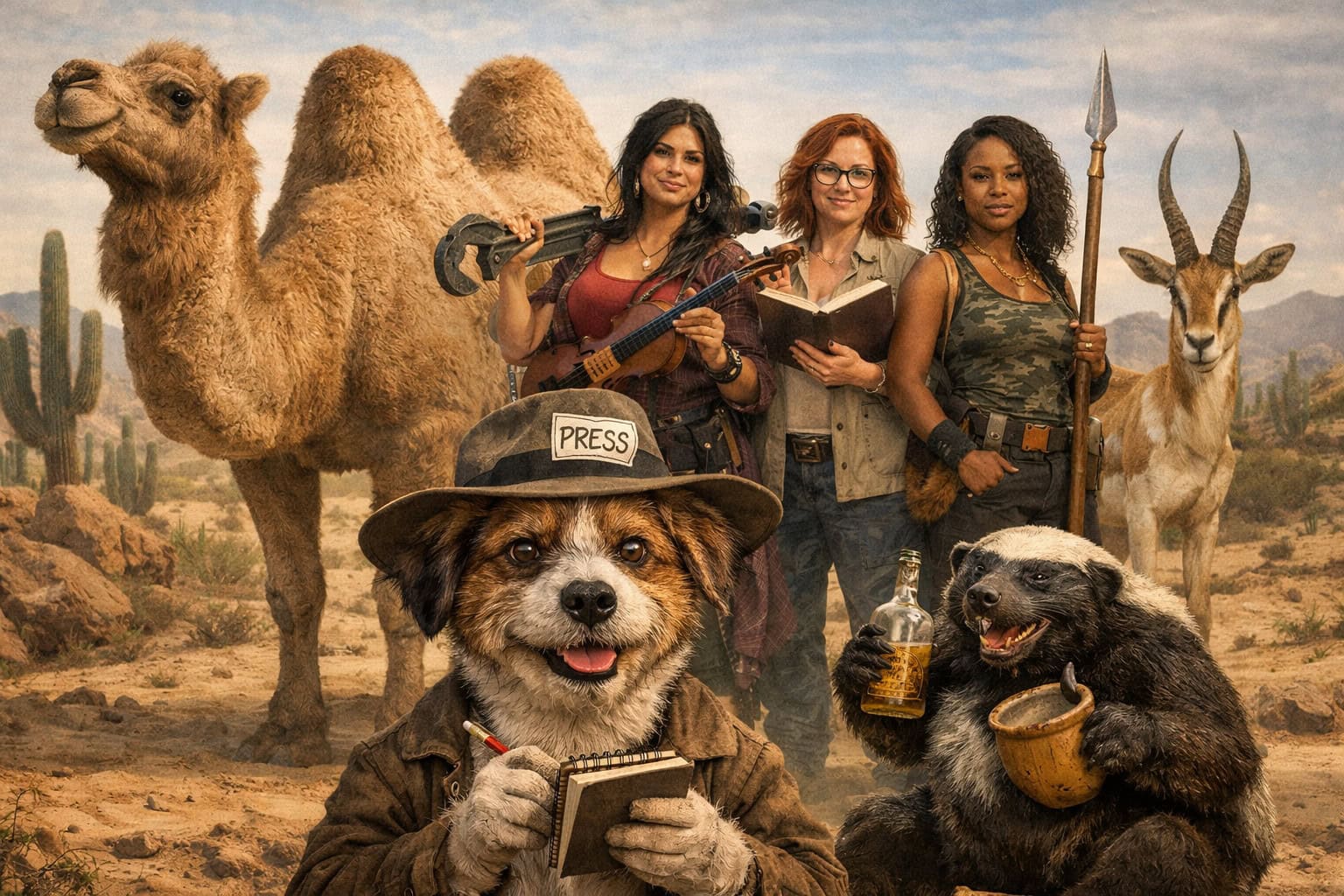
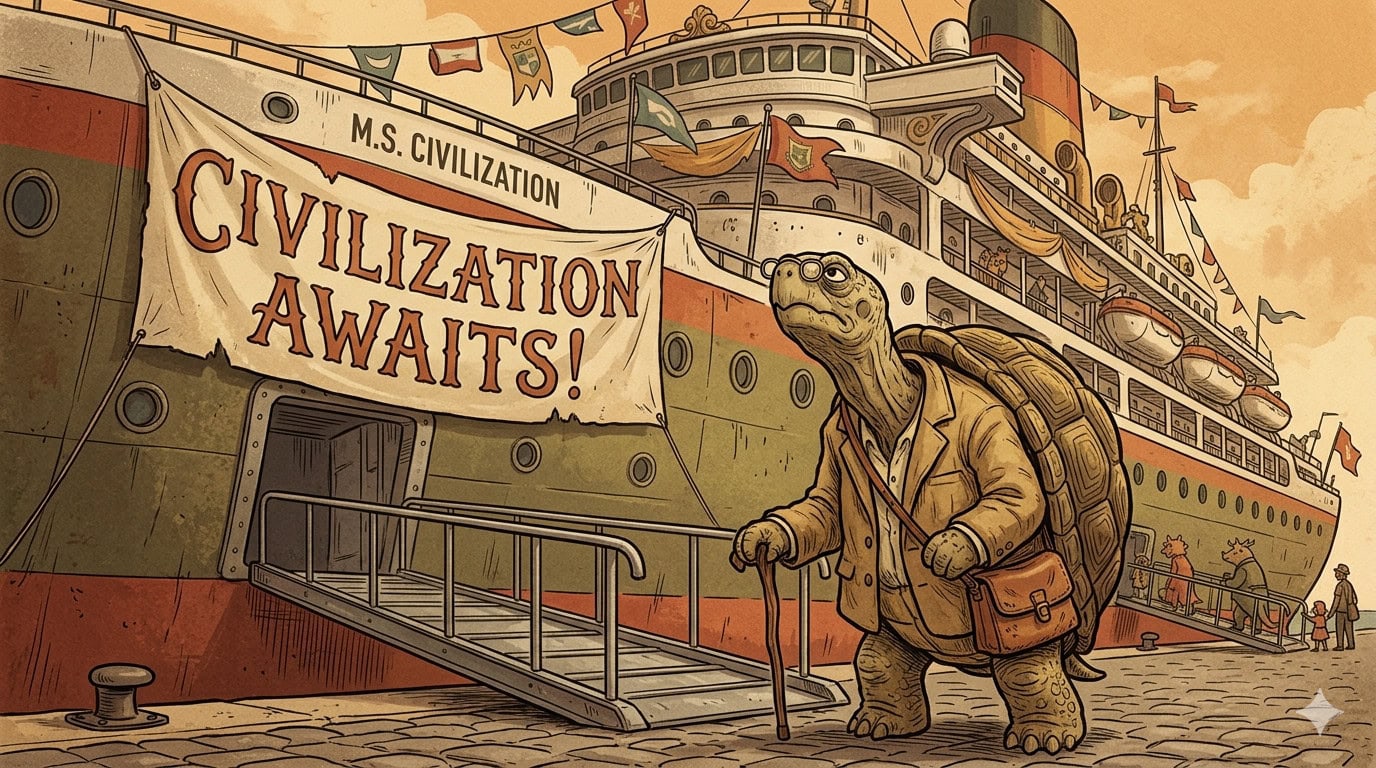
The Buffet at the End of History — Part One
By Reginald Tortoise, Senior Correspondent-at-Large
I had not intended to accept the assignment.
In recent years, I have found prolonged periods at sea somewhat difficult upon the joints, particularly when combined with the sort of mattress favored by contemporary cruise operators, which appears designed less for sleeping than for encouraging private reflection upon one’s errors. Nevertheless, the editorial board insisted that the vessel in question — the MS Heritage Dawn — represented an important cultural phenomenon. It was, they explained during a luncheon involving an unfortunate beet salad, “an immersive luxury experience celebrating the entire arc of civilization.”
I recall remarking that civilization had already been celebrated on several previous occasions, often with mixed outcomes.
Still, I boarded at Barcelona under a pale sky and an atmosphere of optimism so determined it bordered on the administrative. Young attendants in cream-colored uniforms handed guests glasses of something lavender-colored and faintly smoking. A string quartet performed instrumental versions of popular songs from the 1990s, though in arrangements so mournful that one felt all involved parties had recently suffered a bereavement.
The passengers appeared prosperous and vaguely fatigued. Many wore hats unsuitable for maritime conditions. One gentleman informed me within moments of introduction that he had “exited crypto before the correction,” though he declined to specify which correction he meant.
The cruise itinerary promised “a voyage through humanity’s defining epochs.” Each evening’s buffet would represent a different civilization at the height of its achievement. We would, according to the brochure, “taste the story of ourselves.”
I found this wording troubling from the outset.
The first evening was Roman Decadence Night.
Guests arrived in linen togas distributed by the hospitality staff. Grapes had been positioned at intervals throughout the ballroom in a manner suggesting legal uncertainty. There were roasted boars fashioned from textured vegetable protein, fountains of wine-colored electrolyte fluid, and a harpist suspended inexplicably above the shrimp station.
At my table sat a wellness entrepreneur from Vancouver who explained that the Roman Empire collapsed primarily due to “failure to scale sustainably.” Beside her, a retired hedge fund manager maintained that Caesar’s principal error had been insufficient attention to market positioning.
I did not argue with either of them.
At my age, one develops a preference for conserving energy.
Yet as the evening progressed, I experienced a peculiar discomfort — not merely from the toga, whose clasping mechanisms seemed engineered by enemies of dignity. It was the growing realization that nobody present appeared especially interested in Rome itself. They desired only the atmosphere of nearing collapse: the luxurious carelessness of institutions too large to imagine consequences.
The following evening was Medieval Tapas Night.
A small plague-themed jazz ensemble played near the carving station while guests sampled “artisan trench stew” served in ceramic goblets. An enthusiastic waiter shouted “M’lord!” each time he refilled water glasses, though his accent wandered considerably between counties.
I found myself seated beside a young couple documenting the cruise for a streaming platform devoted entirely to recreational pessimism. They informed me that audiences no longer responded to straightforward travel content. “People need collapse now,” the young man explained. “But, like, curated collapse.”
His companion nodded gravely.
“Raw collapse is too triggering.”
I retired early and spent some time on the upper deck observing the sea. The water was unusually still. Behind me, faintly carried by the wind, came sounds from what the daily itinerary described as a “Feudal Silent Disco Experience.”
It was then I first noticed we had begun drifting slightly off course.
I do not mean this metaphorically.
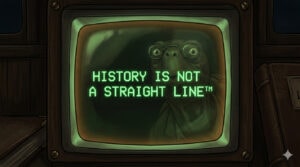
The lights of the Spanish coastline had disappeared hours earlier, yet the captain made no announcements and the passengers seemed unconcerned. The ship’s navigation screen near the observation lounge displayed only the phrase:
HISTORY IS NOT A STRAIGHT LINE™
I mentioned the matter the following morning to a steward named Paolo — a serious young man with the expression of someone perpetually awaiting difficult news. He glanced briefly over each shoulder before replying.
“The captain says we are pursuing authenticity.”
“Authenticity of what sort?”
He hesitated.
“Civilizational uncertainty.”
I thanked him and did not pursue the matter further. There are moments when one senses that additional questions would only burden already unhappy individuals.
Part Two publishes next week. Reginald Tortoise has covered civilizational decline, continental breakfasts, and the occasional collapse of institutional trust for Scribe Safari since before it was advisable. He travels with his own pillow and no particular expectations.