The Tide Pool Incident
By Cosimo — Subterranean (and Subtidal) Affairs Correspondent
I should explain, before I begin, that I have eight arms and that this is more complicated than it sounds.
Most animals with limbs treat them as instruments — tools directed by a central authority toward specific ends. This is, I understand, how it works for dogs, owls, goats, and the other correspondents at this publication. You want your arm to do something; you tell it; it does it. The chain of command is short and unambiguous.
 In my case, the chain of command does not exist in any form that would satisfy an organizational theorist. Two-thirds of my neurons are distributed across my arms. Each arm has its own local processing, its own reflexes, its own capacity to problem-solve without consulting me in any meaningful sense. I am not so much a reporter as I am an editorial collective that has agreed, most of the time, to share a byline.
I mention this because it is directly relevant to what happened at Tide Pool 7 on Tuesday, and why my editor received six separate drafts of this story before I had a chance to reconcile them into a single dispatch.
The assignment was simple. A hermit crab had vacated Pool 7 under unusual circumstances, leaving behind its shell and an unfinished molt that had the other pool residents concerned. Bob asked me to look into it.
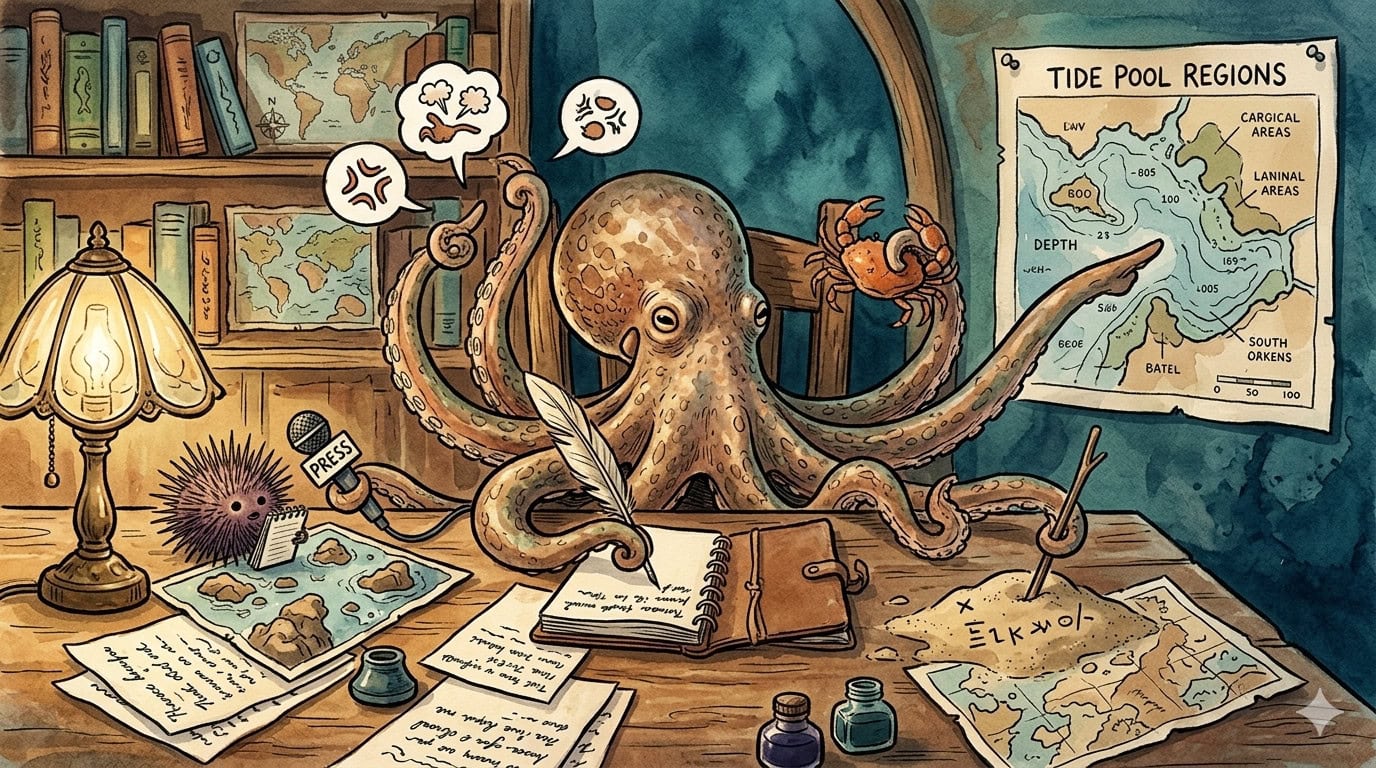
I arrived at approximately 11 a.m. and sent three arms to gather initial impressions. This is standard operating procedure. 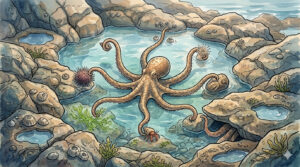
By 11:07, Arm Two had cornered a sea urchin near the north wall and was conducting what I can only describe as an aggressive interview. The urchin claimed to have seen nothing. Arm Two was skeptical, on what grounds I cannot fully reconstruct, because by then I had turned my attention to the hermit crab’s shell, which was sitting upright in the center of the pool in a way that struck me as significant.
By 11:12, Arm Four had independently decided that the case was solved. It had found what it believed to be evidence of a predatory incursion — specifically, a disturbance in the coralline algae on the western edge that, to Arm Four’s assessment, indicated something large had moved through. Arm Four communicated this conclusion to me via the neurochemical equivalent of a very confident memo. I filed it.
Arm Seven, meanwhile, had done something I did not authorize: it had begun writing. I discovered this at 11:19 when I noticed it had inscribed three sentences in the silt with its tip. The sentences were technically accurate but structurally baffling, organized around a theory about tidal timing that I had not yet formed and am not sure I endorse.
Arm Six was eating a small crab it had found under a rock, which is not relevant to the story but worth noting as context for why my attention was, at that point, somewhat fragmented.
Here is what I believe actually happened, assembled from six competing accounts and one set of silt-inscriptions:
The hermit crab molted. During the molt, it was briefly exposed — soft, vulnerable, the shell not yet reoccupied — and moved to a location in the pool it judged to be safer. The shell remained. There was no predatory incursion. The disturbance in the algae was caused, in all probability, by me, specifically by Arm Four conducting its investigation.
The sea urchin knew nothing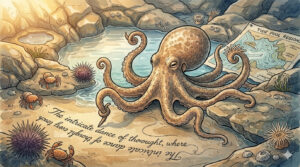 and Arm Two owes it an apology.
The tidal timing theory in the silt is, on reflection, interesting. I may develop it further. It is not relevant to this story.
There is a paper — published in 2021 in Current Biology — that describes how octopus arms, when separated from the body, continue to respond to stimuli and attempt to pass food toward where the mouth used to be. The arm does not know the octopus is gone. It has, in some sense, its own agenda.
I read this paper and found it clarifying rather than unsettling. What it suggests is that the octopus is less a self with appendages and more a negotiation among selves that has agreed, provisionally, on certain priorities. The arm reaching for food after separation is not confused. It is doing what it has always done. The central authority, it turns out, was never as central as it appeared.
I think about this when I am trying to file a single coherent story. What I am actually filing is a consensus document — the position that the majority of my processing has agreed to hold, at least until new information arrives. My editors should know this. It does not make the reporting less accurate. It makes it more accurate than most, actually, because nothing gets suppressed before I even know it’s there.
Arm Seven disputes the conclusion about the hermit crab. I note its objection and will investigate further. It is currently writing something in the silt again, and I have decided to let it.
Cosimo covers subtidal affairs for Scribe Safari. He files from a rocky intertidal zone on the central coast and asks that readers not tap on his tank, as three of his arms find it startling even when the other five do not.