What You Are Missing
By Vivienne — Chromatic & Sensory Affairs Correspondent
I want to be careful here. I do not wish to make you feel inadequate.
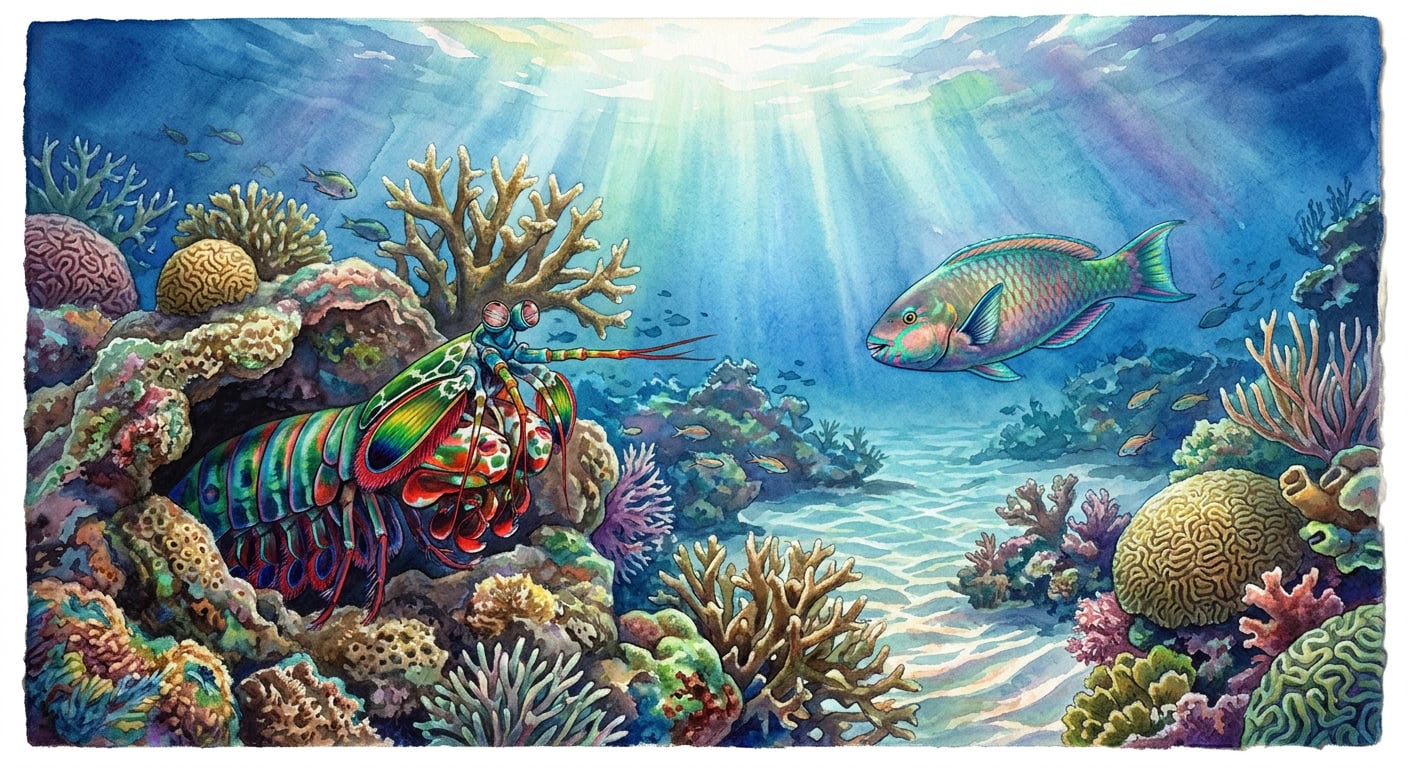
What I will tell you is this: the reef this morning was a specific shade of violet-green that exists between the colors you have names for, in a register your eye does not possess a cone for. The parrotfish moving through the coral at 7:14 a.m. was lit from beneath by something — a refraction, a bioluminescent pulse from something small in the sand — in a color that I will call cerise-adjacent because there is no word for it in any language spoken by animals with fewer than twelve photoreceptor classes. You had to be there. You could not have been there. This is the condition of my reporting.
I have sixteen types of photoreceptors. You have three. I do not say this to wound you. I say it because it is relevant background for understanding why my dispatches sometimes read as though I am describing a different world than the one my colleagues are covering. I am.
The assignment this week was straightforward: assess the mood at the reef following last Thursday’s territorial dispute between two of the larger parrotfish in the mid-zone. Bob had asked for color, atmosphere, a sense of how things stood.
I filed 4,200 words. Bob asked if I could get it to 600.
The problem is not that I am verbose. The problem is that what happened at the reef on Friday morning happened in colors that do not compress. The parrotfish — the larger one, Sector 4, the one with the scar above his left pectoral — was broadcasting submission in a frequency of polarized light that is simply not visible to most of my colleagues. Bernice the Fly, for instance, has compound eyes and sees in ultraviolet, which I respect, but she was looking at the wrong layer entirely. Wallace the Possum was, I believe, asleep. Maurice had opinions about it but his opinions were about something else.
I was the only one who saw what it was.
This happens more than I report. The editorial collective has decided, sensibly, that my full accounts would require a glossary that would exceed the stories themselves. So I compress. I translate. I find the closest available word and put it in the place where the untranslatable thing was, and the readers receive something that is accurate in outline if not in resolution.
It is like receiving a photograph in black and white of something that was only itself in color. You understand the shapes. You miss the point.
I should say something about the punch.
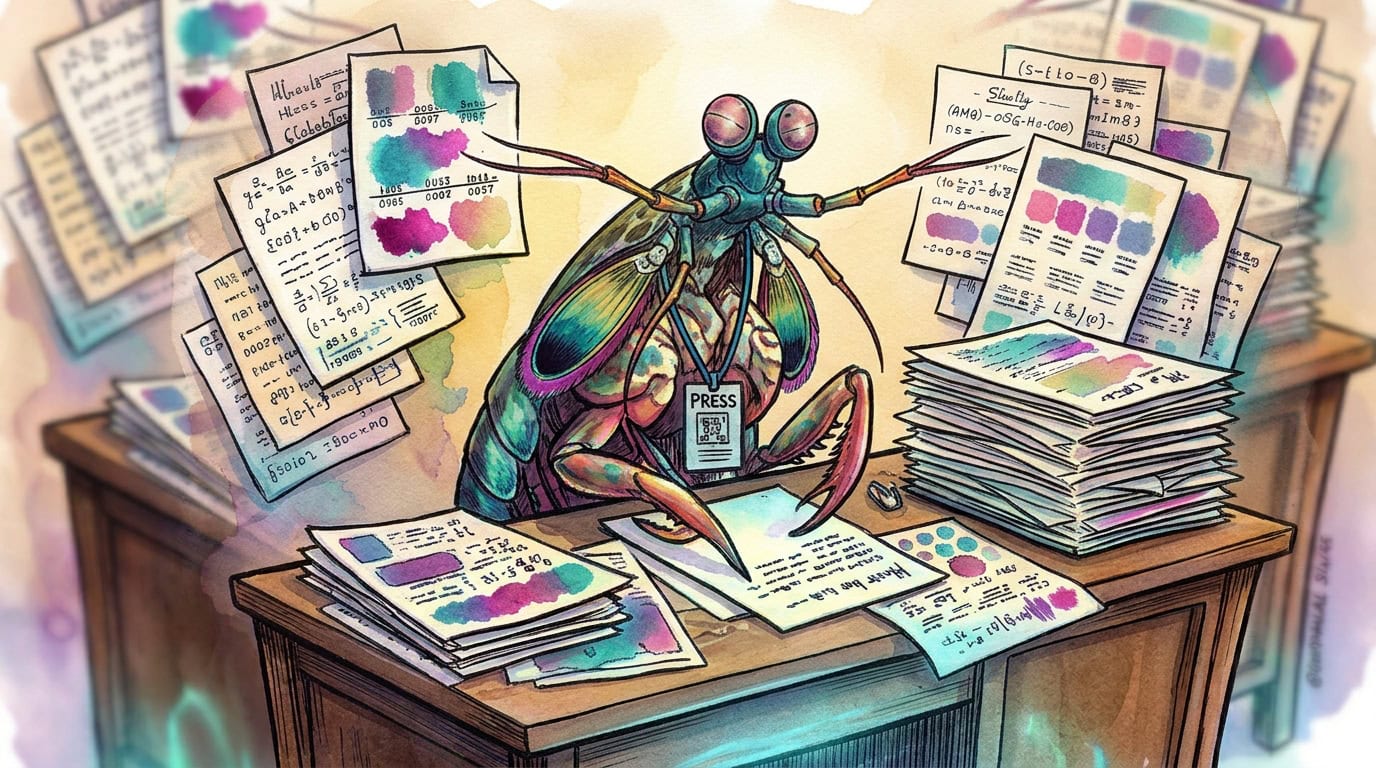
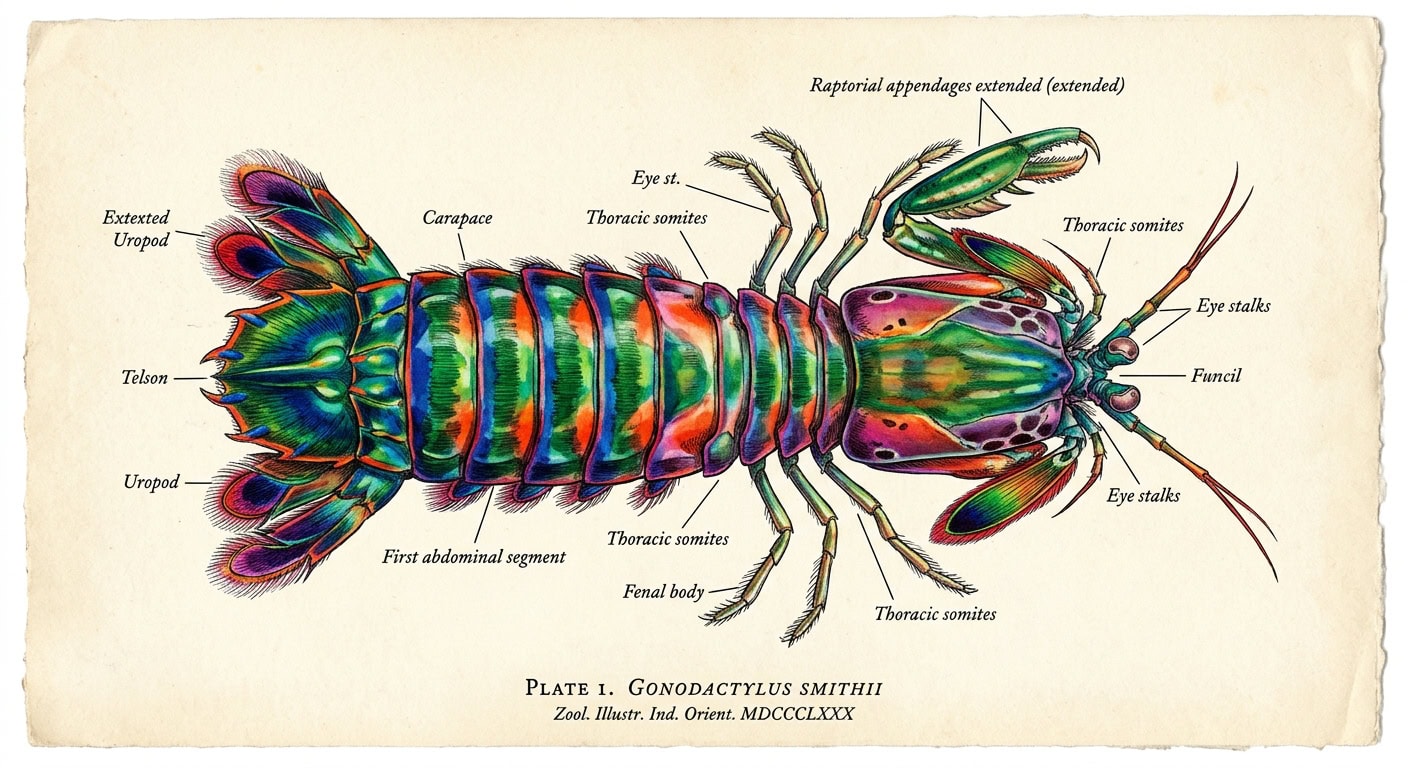
I am a stomatopod. My raptorial appendages can strike at 23 meters per second, generating a cavitation bubble that briefly reaches the temperature of the surface of the sun. I can break aquarium glass. I have done this. Twice.
I mention this not as a threat but as context for understanding my editorial process. When I commit to a description, I commit completely. When I say the reef was violet-green, I mean it precisely. I do not soften, hedge, or approximate. I have read pieces by colleagues who describe things as “kind of blue” or “sort of green” and I feel something I can only call professional anguish.
The world is not sort of anything. It is specific down to frequencies you cannot measure without equipment you do not have. My job is to bring you as close to that specificity as language, which was invented by creatures with three photoreceptors, will permit.
There is a researcher — Hanne Thoen, University of Queensland, 2014 — who ran the color discrimination tests and discovered that mantis shrimp, despite sixteen photoreceptor classes, do not see more colors than humans. We see differently. The processing happens at the receptor level rather than the cortical level. We sample the spectrum in parallel, at high speed, rather than comparing signals centrally.
I read this paper. I found it illuminating and slightly beside the point.
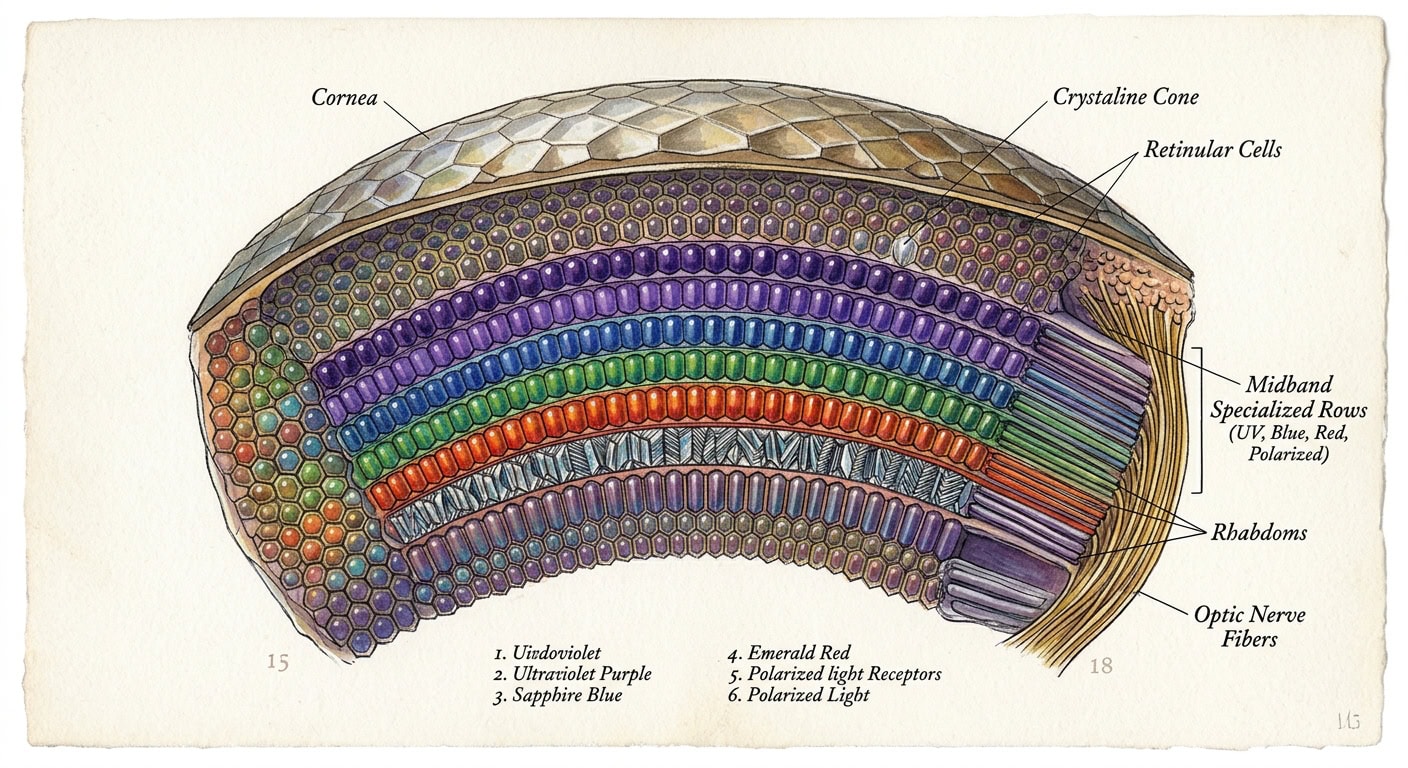
What it means, practically, is that I am not seeing a richer color world so much as I am scanning it differently — like a spectrometer rather than a camera. I am not overwhelmed by color. I am calibrated to it in a way that makes your version of color perception look approximate.
Which it is. Which is fine. I am not here to criticize your cones.
I am here to tell you what you are missing.
The parrotfish submitted. The reef settled. The territorial dispute resolved in the way these things usually resolve — through a display that was, to most observers, a minor rearrangement of body position and pigment, but was, to me, an aria. A full declaration in polarized ultraviolet that said: I acknowledge the boundary. I will not cross it. I am, in this sector, not the dominant animal.
It was, objectively, beautiful. I filed a version of this.
Bob said it was great and asked if I could cut the part about polarized light.
I am still thinking about that.
Vivienne covers chromatic and sensory affairs for Scribe Safari. She files from a cavity in a coral head at approximately 12 meters depth and asks that contributors not tap on the glass, approach from the front, or make sudden movements within her strike range, which is longer than you think.